
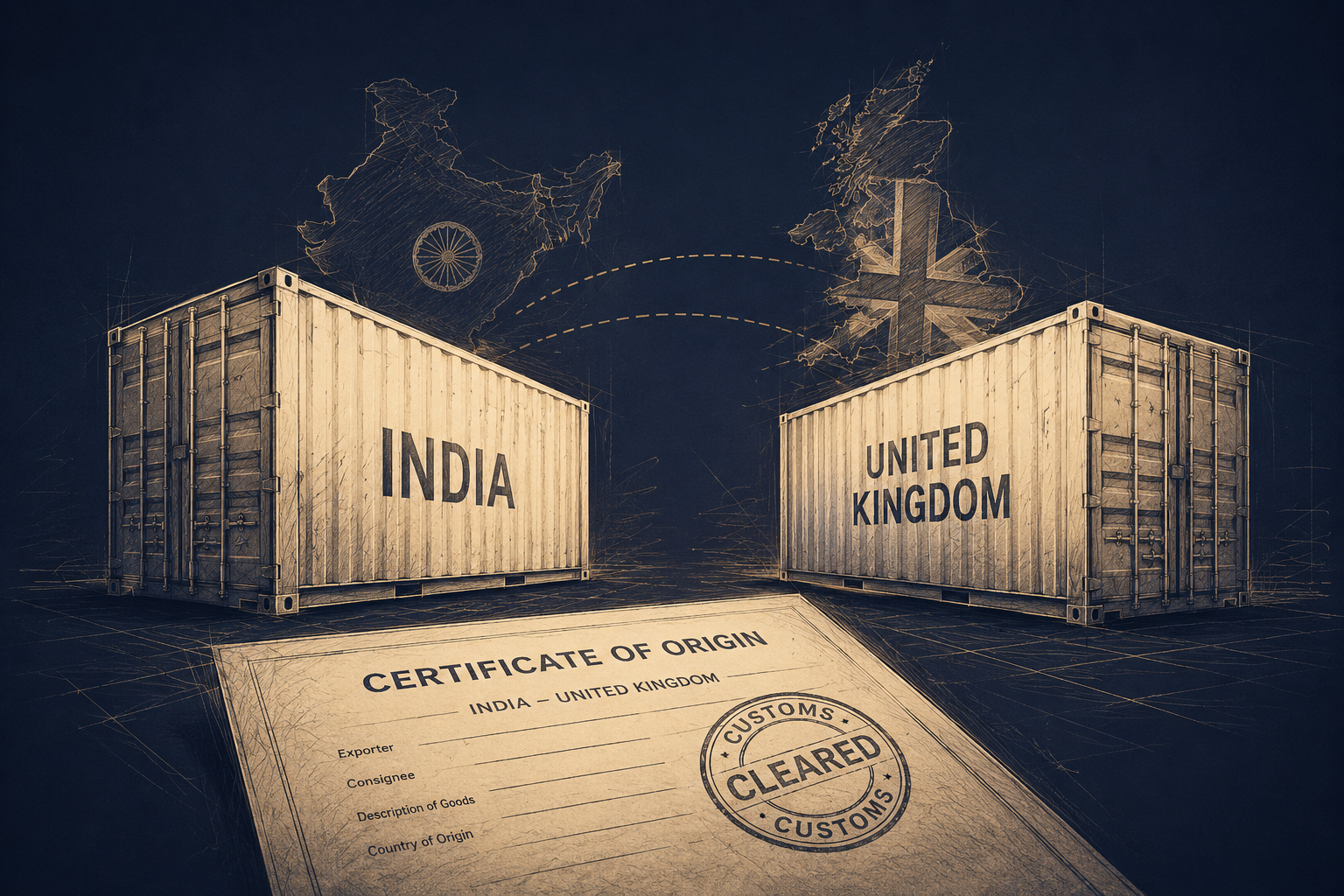
India-UK Trade Deal Goes Live in Four Days: What Rules of Origin Mean for Every Indian Exporter
The India-UK Comprehensive Economic and Trade Agreement takes effect on July 15, 2026, giving 99 percent of India's exports duty-free access to the UK. But the tariff benefit only applies if you can prove your goods actually originate in India. Here is exactly what the new Rules of Origin require and what exporters need to do right now.
The Deal That Took Years, Now Four Days Away
India and the United Kingdom signed the Comprehensive Economic and Trade Agreement, or CETA, on July 24, 2025, after years of negotiations that began in January 2022. On July 3, 2026, the Central Board of Indirect Taxes and Customs notified the Rules of Origin framework under Notification No. 62/2026-Customs (N.T.). The agreement comes into force on July 15, 2026.
This is historic. CETA provides duty-free access for 99 percent of India's exports to the UK, covering almost the entire export basket. Trade between India and the UK reached USD 25.12 billion in 2025-26, an increase of 8.62 percent from the previous year, with India maintaining a trade surplus. Sectors like textiles, leather, footwear, marine products, sports goods, toys, gems and jewellery, engineering goods, auto components, and organic chemicals are expected to benefit most.
But here is the catch that every exporter absolutely needs to understand. A trade agreement's tariff benefits do not apply automatically to everything you ship to the UK. They apply only to goods that qualify as originating in India under the Rules of Origin. If your goods do not meet those rules, your UK buyer pays the standard import duty, not the preferential rate. The commercial advantage of the agreement disappears entirely.
What Are Rules of Origin and Why Do They Matter?
Rules of Origin are the legal criteria that determine which country a product actually comes from for trade purposes. They exist to prevent what is called "tariff jumping" or "trade deflection," where a company from a third country, say China or Vietnam, ships goods to India, does minimal processing, and then re-exports them to the UK claiming Indian preferential duty rates.
To prevent this, CETA's Rules of Origin require that goods claiming preferential treatment must genuinely originate in India or the UK. The rules establish three ways a product can qualify.
The first is the wholly obtained criterion. If your product is entirely grown, extracted, or produced in India using only Indian materials and labour, it is wholly obtained in India and qualifies automatically. This applies most directly to agricultural products, minerals, and fisheries.
The second is the substantial transformation criterion. This is the most important and complex route for manufactured goods. If your product uses materials from third countries, those materials must undergo sufficient processing or transformation in India to change their essential character. The CBIC notification includes Product-Specific Rules of Origin that set out exactly what transformation is required for each tariff heading or product category.
The third is the cumulation provision. A distinctive feature of CETA is that it allows cumulative treatment of originating materials. Inputs that originate in either India or the UK can be treated as originating in the other country when they are used in further production. This is particularly valuable for supply chains where components move between India and the UK during the production process.
What Will Not Work: The Disqualifying Operations
The notification is explicit about what does not count as sufficient transformation to confer origin. A long list of simple operations will not qualify goods for preferential treatment even if they are performed in India.
Simple packaging, relabelling, washing, sorting, polishing, dilution, repacking, and simple assembly are all specifically excluded. This is important for importers who buy semi-finished goods from third countries, perform minor finishing in India, and then export to the UK. Under CETA's Rules of Origin, those goods will not qualify as Indian-origin unless the Indian processing genuinely transforms the product in a way that goes beyond these excluded operations.
For example, a company that imports garment components from a non-CETA country, assembles them in India into a finished garment, and then exports to the UK will need to check whether the assembly operations performed in India meet the specific product transformation requirements for apparel under the agreement. Generic assembly or simple sewing may not be enough.
How to Prove Origin: The Documentary Requirements
Proving that your goods qualify is not just a production question. It is a documentation discipline that must be in place before the first shipment.
Importers in the UK who want to claim preferential tariff rates must support their claims with valid proof of origin. For goods exported from India to the UK, the proof of origin will generally be an origin declaration completed by the exporter or manufacturer. This is a self-certification model, meaning you are declaring on the basis of your own knowledge and records that the goods meet the origin requirements. That self-certification carries legal weight and can be verified.
The Department of Commerce or agencies notified by the government for the issuance of certificates of origin are the competent authority in India for origin certification. Exporters need to ensure their documentation infrastructure is ready to support these declarations before they ship.
On record retention, the rules are specific. Importers must retain records supporting preferential tariff claims for at least four years. Exporters and manufacturers must maintain origin-related documents for a minimum of five years. These documents include production records, sourcing records, value addition calculations, supplier declarations, and anything else that demonstrates how the goods meet the applicable origin rule. If your records cannot support the claim at verification, the preferential duty rate can be denied retroactively and the importer faces a demand for the duty differential.
The Four Things Every Indian Exporter Should Do Before July 15
Review your supply chain for each product you intend to export to the UK under CETA. Identify all input materials, where they come from, and at what value they enter the production process. Map this against the relevant Product-Specific Rule of Origin for your product's tariff classification.
Obtain the CBIC notification and identify the applicable rule for your product. The notification includes detailed annexures with product-specific conditions. The rule for textiles will be different from the rule for engineering goods, which will be different again from organic chemicals. There is no shortcut to checking the specific rule that applies to you.
Set up your documentation system before the first preferential shipment. Origin declarations must be made on proper documentation. Your record-keeping system must be able to produce, on demand, the sourcing records, value addition workings, and production documentation that support the declaration you are making. Setting this up after a query from UK customs is too late.
Talk to your UK buyer about the import side. The preferential duty rate at the UK border is claimed by the importer, your UK buyer. They need to understand the documentation required, how to make the preferential claim on their customs entry, and what records they need to retain. The agreement benefits both parties, but both parties need to be operationally ready for it.
The Bigger Picture: What CETA Means for India-UK Trade
CETA is the most significant bilateral trade agreement India has concluded with a major Western economy. The UK is India's sixth-largest trading partner and among the top five countries for Indian exports. Duty-free access for 99 percent of India's export basket is a structural shift in the competitiveness of Indian goods in the UK market.
For labour-intensive sectors, the opportunity is immediate and substantial. Indian textiles, leather goods, and footwear currently face UK tariffs that CETA will eliminate. For gems and jewellery, the duty saving on a single large shipment can be significant. For engineering goods and auto components, the competitive advantage over non-CETA suppliers is real and quantifiable.
But the opportunity only converts into actual benefit if exporters do the compliance work. A preferential tariff rate you are entitled to but cannot claim because your documentation is not in order is the same as no preferential rate at all. The Rules of Origin notification is not bureaucratic fine print. It is the mechanism through which the agreement's benefits become real.
July 15 is four days away. The agreement is ready. The question is whether your documentation is.
This news is for general informational purposes and does not constitute legal advice. For guidance on India-UK CETA compliance, Rules of Origin assessments, or customs and trade matters, please contact our team.