
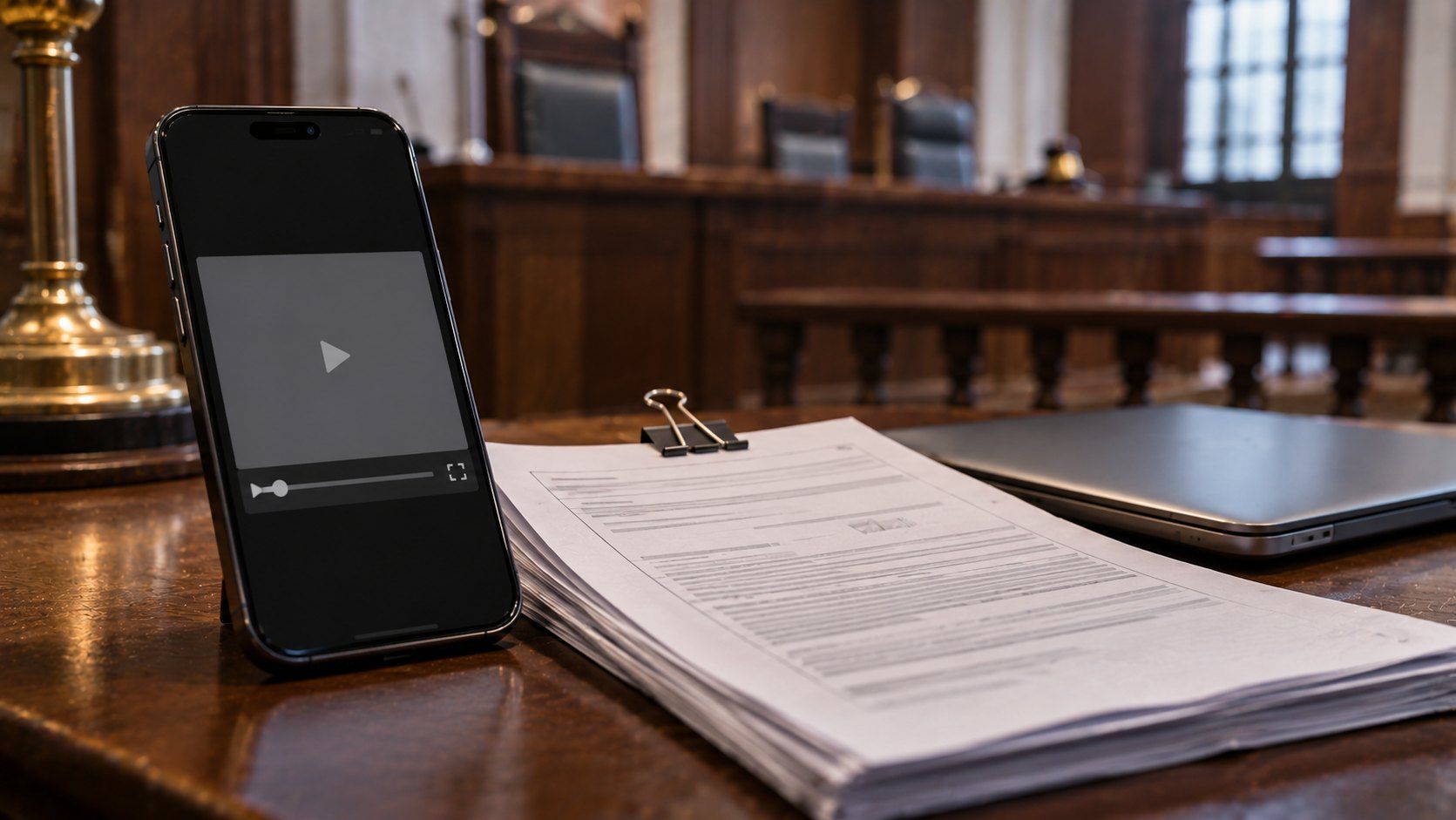
On Thursday 19 November 2026, a Division Bench of the Delhi High Court, comprising Acting Chief Justice Nitin Wasudeo Sambre and Justice Sanjay Sharma, issued notice on a petition by LiveLaw Media Private Limited and its Director Sindhu T.P. against the Union of India and Meta Platforms Inc. The petition seeks to strike down Rule 4(4) of the Information Technology (Intermediary Guidelines and Digital Media Ethics Code) Rules, 2021, as amended, and challenges the restriction of three of LiveLaw's Instagram reels on Supreme Court proceedings. The court made no findings. The account below is based on a news report, which itself records the arguments only, and not on the court's written order.
What Happened
The petition, LiveLaw Media Private Limited and another v. Union of India and others, states that three reports on Supreme Court proceedings were restricted on LiveLaw's verified Instagram account. The first, dated 27 October, was restricted within about 15 minutes and restored the same evening. The second, of 29 October, and the third, of 30 October, remain inaccessible in India. The plea says there was no blocking order, no reasoned intimation and no notice. Meta reportedly said the content was reviewed against its policies and restricted where it conflicted with local law.
Legal notices sent to the Centre and Meta on 30 October went unanswered. The plea adds that a further reel was taken down on 18 November, following a Delhi Police affidavit filed before the Supreme Court.
Advocate Apar Gupta appeared for LiveLaw and Additional Solicitor General Chetan Sharma for the Union. The Union's counsel said that the petition could be treated as a representation and that a speaking order would be passed. LiveLaw's counsel said that would be a mere formality, and said they were not pressing for interim relief that day. The Court permitted the respondents to file their counter within four weeks and listed the matter for 18 January 2027. Identical matters are listed for 9 February 2027.
The Background: How Content Is Blocked in India
Section 69A of the Information Technology Act, 2000 allows the Central Government to direct blocking of public access to information in specified circumstances, such as the sovereignty and integrity of India, the security of the State and public order, after following a prescribed procedure. In Shreya Singhal v. Union of India, the Supreme Court upheld Section 69A because of its procedural safeguards, including reasons recorded in writing and the possibility of judicial review.
Separately, the 2021 Intermediary Rules require social media intermediaries to follow due diligence. Rule 4(4), as amended, is the provision the petition attacks. As described in the report, it requires mandatory automated blocking of content identical to material that has already been blocked.
The Petitioners' Arguments
The petition argues that Rule 4(4) is ultra vires the Information Technology Act, 2000 and violates Articles 14, 19(1)(a), 19(1)(g) and 21 of the Constitution. It says that mandatory automated blocking of content identical to previously blocked material amounts to prior restraint, and that it makes intermediaries decide the legality of content for themselves, bypassing the procedure and safeguards under Section 69A. It also challenges two advisories of the Ministry of Electronics and Information Technology dated 8 and 10 October as lacking a statutory basis, and refers to Rule 3(1)(d) in its prayers.
These are the petitioners' contentions. The respondents have not yet filed their reply and the Court has not expressed a view.
Why It Matters
The case raises a question that goes beyond one news organisation. When a platform removes content on its own because a rule requires it to match and block identical material, who decides whether the content is lawful, and where can the affected person be heard? If an intermediary acts without a formal blocking order, the speaker may not know what was blocked or why.
Reports on court proceedings are also at the centre of the dispute. The right to report on open court hearings is widely understood to be part of freedom of the press, and any restriction would need to satisfy constitutional tests.
For platforms, the outcome will affect how automated systems are designed. For publishers, it will indicate what remedies are available when content is removed without notice. For citizens, it relates to how much online speech can be restricted through technical rules.
What Comes Next
The Union and Meta have four weeks to file their counter, and the matter returns to Court on 18 January 2027, with similar cases to be heard on 9 February 2027. The Union has indicated it may treat the petition as a representation and pass a speaking order, which could produce a record of its reasons before the final hearing. Readers should watch for the written order and the replies.