
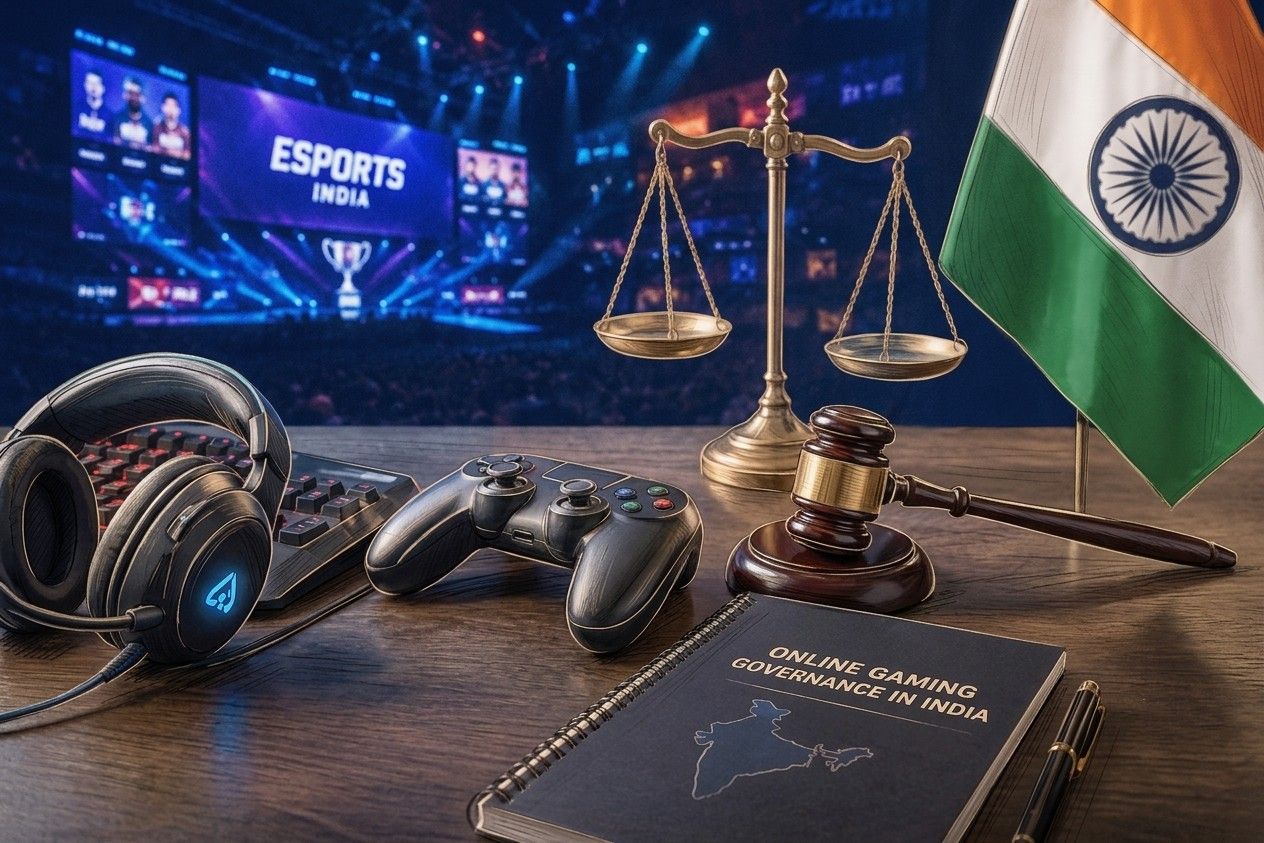
The research examines the legal, technological, and regulatory evolution of gaming and e-sports governance in India, highlighting how rapid technological growth in the gaming industry has created complex legal and policy challenges. India currently has more than 400 million gamers and a rapidly expanding digital gaming market, which has forced policymakers and courts to reconsider outdated gambling laws and develop modern regulatory mechanisms. It discusses how the gaming ecosystem, once regulated by colonial laws such as the Public Gambling Act of 1867, has gradually transitioned into a modern framework shaped by judicial precedents, technological developments, and legislative reforms aimed at balancing innovation with public safety.
It further explains how the Indian judiciary played a crucial role in distinguishing between gambling and games of skill, which became the foundation of gaming regulation. Through landmark judicial decisions, courts established the “preponderance of skill” doctrine, which states that activities where skill predominates over chance cannot be treated as gambling and therefore fall under the protection of the right to trade and profession under Article 19(1)(g) of the Constitution. Cases such as R.M.D. Chamarbaugwala (1957), State of A.P. v. K. Satyanarayana (1967), and K.R. Lakshmanan (1996) shaped the legal framework by recognizing competitions like rummy, fantasy sports, and horse racing as skill-based activities.
It also discusses the fragmented regulatory landscape in India, where individual states regulate betting and gambling under the State List, resulting in varied approaches across the country. Some states impose strict prohibitions on real-money gaming while others implement licensing systems for online gaming platforms. To address the limitations of outdated laws, the government introduced the Information Technology Rules Amendment in 2023, which created the concept of Online Gaming Intermediaries (OGIs) and imposed strict compliance requirements such as grievance officers, KYC verification, transparency in withdrawals and winnings, and oversight by self-regulatory bodies.
A major focus is placed on the Promotion and Regulation of Online Gaming Act, 2025 (PROGA), which represents a major shift in India’s gaming policy. It highlights how the law introduces stricter standards for distinguishing skill-based games by requiring skill to be the decisive factor rather than merely predominant. It also establishes a central regulatory authority known as NOGRA (National Online Gaming Regulatory Authority) and introduces strong enforcement mechanisms including platform blocking powers, criminal penalties, and financial sanctions for non-compliant operators. One of the most controversial provisions discussed is the complete ban on Online Money Games (OMGs), which prohibits games where users deposit money with the expectation of winning rewards.
It further explores the security challenges and cybercrime risks within the gaming ecosystem, particularly in relation to popular games such as Battlegrounds Mobile India (BGMI) and Free Fire. Rapid growth in online gaming has created opportunities for fraud networks, scams, and financial crimes targeting gamers. Examples include the UC coin discount scam, carding operations involving stolen credit card data, and digital arrest scams where criminals impersonate law enforcement officials to extort money. These incidents demonstrate the lack of standardized security protocols and highlight vulnerabilities in digital wallets and online payment systems.
It also analyzes the technical and structural causes behind gaming-related fraud, including weak authentication systems, loopholes in age-verification technologies, and fragmented regulatory enforcement. Camera-based KYC systems can be easily manipulated through spoofing techniques such as high-quality masks or printed photos. In addition, offshore gaming platforms often bypass domestic regulations using VPNs and cryptocurrency transactions. It emphasizes that predatory game design practices—such as hidden in-game currency conversions and psychologically manipulative reward mechanisms—can also lead to addiction and financial exploitation of young players.
To address these challenges, it proposes a multi-layered regulatory and technological solution aimed at creating a safer and more ethical gaming ecosystem. Suggested solutions include the development of a “GameSafe” framework, which integrates blockchain transparency, AI-driven fraud detection systems, privacy-preserving age verification technologies, and self-exclusion tools that allow players to limit their time and spending. It also recommends aligning Indian regulatory practices with global standards such as the UK Online Safety framework, which focuses on platform accountability, proactive moderation, and financial vulnerability checks.
Finally, it highlights the growing importance of e-sports as a legitimate skill-based discipline in India. The government has started promoting competitive gaming through initiatives such as the Khelo India Mission and national sports funding programs, aiming to develop infrastructure, talent training, and sports science integration. By separating e-sports from gambling activities and recognizing it as a professional sporting discipline, India aims to create a sustainable and regulated ecosystem that supports athletes, protects users, and positions the country as a global hub for competitive gaming.
Key Points Covered in It
- Evolution of gaming laws from Public Gambling Act 1867 to modern digital regulations
- Role of Supreme Court judgments in defining skill vs chance
- Introduction of IT Rules Amendment 2023 for online gaming intermediaries
- Implementation of the Promotion and Regulation of Online Gaming Act, 2025 (PROGA)
- Creation of NOGRA as the central regulatory authority
- Ban on Online Money Games (OMGs) and stricter legal framework
- Rise of cyber fraud, scams, and carding in gaming platforms
- Technical loopholes such as spoofing, weak KYC, and offshore betting platforms
- Proposed GameSafe security framework and technological solutions
- Growth and institutional recognition of e-sports as a skill-based profession in India