
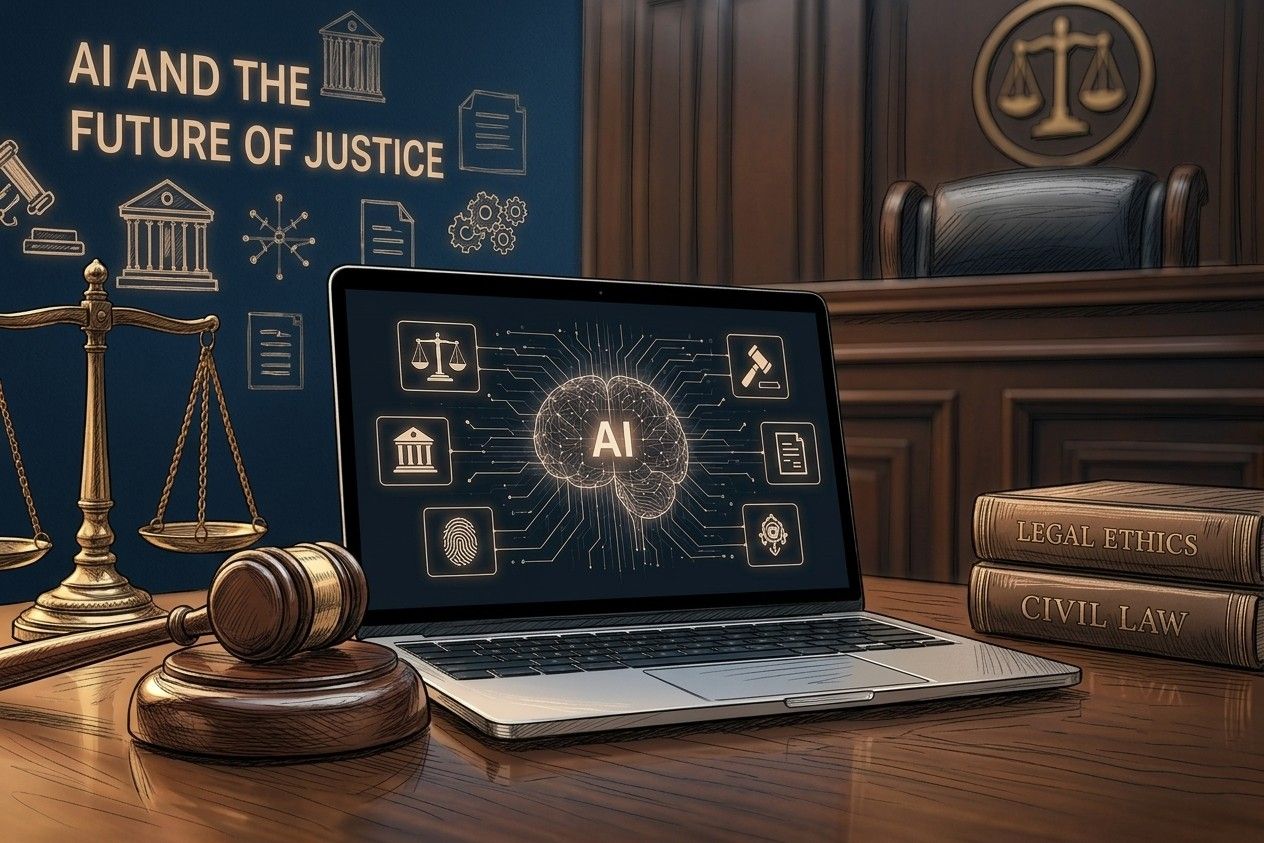
This research examines how the increasing use of Artificial Intelligence (AI) is transforming the global legal system and how this transformation may lead to the gradual diminishment of traditional legal standards. It discusses how AI tools, which were initially introduced to improve efficiency, cost management, and speed in legal work, are now deeply integrated into legal practice. However, while these technologies promise productivity and automation, they also raise serious concerns regarding judicial integrity, professional ethics, transparency, and the protection of fundamental legal principles such as due process and fairness. The study evaluates the structural changes caused by AI and highlights the need for responsible regulation and human supervision in the justice system.
It explains that the legal profession is experiencing a rapid increase in the adoption of AI tools. By 2025, a large percentage of lawyers are expected to rely on AI for tasks such as legal research, drafting documents, and analyzing case data. While this automation improves efficiency and productivity, it also changes the traditional functioning of law firms and legal professionals. AI is increasingly being used not only for administrative work but also for substantive legal drafting and decision-support processes, which were earlier performed only by trained lawyers.
The study further highlights several risks and challenges created by the use of AI in legal practice. One of the major concerns is the reduction in professional accuracy and ethical standards, particularly due to AI-generated errors and fabricated information. Instances have been recorded where lawyers relied on AI-generated legal citations that did not actually exist, resulting in misleading submissions before courts. Such incidents demonstrate the importance of human verification and professional responsibility when using AI tools in legal work.
Another major issue discussed is the impact of AI on legal training and professional development. Traditionally, junior lawyers learned essential legal skills through manual research, document review, and drafting work. However, with AI performing these tasks automatically, young lawyers may lose opportunities to develop deep analytical reasoning and critical legal thinking. This may create a long-term skills gap within the legal profession.
The research also examines algorithmic bias and discrimination in AI systems. Since AI models are trained on historical data, they often reproduce existing social and institutional biases present in that data. For example, predictive policing systems and risk assessment tools may disproportionately target certain communities due to biased historical records. Such outcomes raise serious concerns about fairness, equal protection under the law, and the risk of automated discrimination within the justice system.
Another significant challenge discussed is the lack of transparency in AI decision-making systems, often referred to as the “black box” problem. Many AI tools used in the legal system operate through complex algorithms that cannot be easily understood or questioned by lawyers, judges, or defendants. This lack of explainability threatens the principle of due process, since individuals affected by these decisions may not be able to challenge how the decision was reached.
The article also highlights emerging evidentiary risks caused by deepfakes and synthetic media. AI can now generate highly realistic audio, video, and documents that may appear authentic but are entirely fabricated. This creates difficulties for courts in verifying the authenticity of digital evidence and may undermine public trust in the legal system.
Key Points Covered in the Article
- Increasing global adoption of AI in legal practice.
- Transformation of law firm operations and legal workflows.
- AI-generated errors, hallucinations, and fabricated legal citations.
- Decline in foundational legal training for junior lawyers.
- Algorithmic bias and discriminatory outcomes in predictive tools.
- Transparency issues caused by “black box” AI systems.
- Risks of deepfake evidence and synthetic media in courts.
- Growing concerns about public trust in the justice system.
- Emerging global regulatory frameworks such as AI governance models.
Finally, it concludes that artificial intelligence should not replace human judgment in the legal system. Instead, it should function as a supportive tool that assists lawyers while preserving human reasoning, ethical responsibility, and fairness. Effective regulation, transparency, and professional oversight are necessary to ensure that AI strengthens rather than weakens the integrity of justice.